
Strategic Development Priorities of the Faculty
On October 20. 2023, in accordance with Order No. 369/1, the Faculty of Natural Sciences was established.
The Mission of the Faculty of Natural Sciences is to prepare highly qualified specialists in the field of natural sciences who are capable of addressing the pressing challenges of modern times.
To achieve this goal, the faculty performs the following objectives:
- Ensuring a high level of specialist training in the field of natural sciences that meets international standards.
- Developing research and development activities within the natural sciences.
- Collaborating with the world's leading scientific centers and organizations.
The faculty staff, recognizing their full responsibility to society, consistently adheres to the principles of mutual respect and trust, both within the team and in relationships with students. We foster professional creativity and initiative, maintaining a spirit of teamwork and unity of purpose.
In accordance with the mission of the Faculty of Natural Sciences, its activities are aimed at the following outcomes:
- Graduates possess profound knowledge and skills in the natural sciences, necessary for successful professional activity across various sectors.
- The Faculty makes a significant contribution to the development of science and education by conducting fundamental and applied research.
- The Faculty serves as a center for the dissemination of knowledge, popularizing natural sciences among the general public.
Achieving these results will enable the Faculty of Natural Sciences to contribute to the development of society and the resolution of contemporary global issues.
Research
The Faculty places significant emphasis on the research activities of both the teaching staff and students. Furthermore, faculty members are frequent winners of various competitions and recipients of prestigious research grants.
Department of Mathematics
Grant projects funded by the Ministry of Science and Higher Education of the Republic of Kazakhstan (MSHE RK):
- Spectral issues of non-classical type degenerate differential operators. Implementation: 2013–2015. State registration №0113РК01066.
- On the bounded invertibility and spectral properties of singular mixed-type differential operators. Implementation: 2015–2017. State registration №0115РК02936.
- AP05131080: "Existence of the resolvent and discreteness of the spectrum of hyperbolic-type singular differential operators in $L_p$ space." Implementation: 2018–2020. State registration №0118РК01098.
- AP08855802: "Existence of the resolvent, compactness, and estimation of eigenvalues and s-numbers of mixed-type operators with rapidly growing and highly oscillating coefficients in $L_p$ space." Implementation: 2020–2022. State registration №0120РК00618.
- АР19676466: "Maximal regularity and differential properties of solutions for third-order singular partial differential equations." Implementation: 2023–2025.
Scientific Publications:
Over the last five years, department scholars have published 15 scientific articles in Scopus and Web of Science databases. Most were published in high-impact journals (Q1, percentile above 90).
Department of Physics and Informatics
- Under the supervision of A.T. Nurberdiyev, 3rd-year student Aidos Yergali (Educational Program: "Physics Teacher Training") was awarded a II degree diploma at the 2024 Republican Competition of Student Research Works (NIRS).
- Research Metrics & Publications:
- Articles in Scopus – 4
- Grant funding – 1
- Monographs – 3
- Articles recommended by KOKSNVO (Committee for Quality Assurance in Science and Higher Education) – 18
- Republic-level journals – 11
- International journals – 27
- Republican conference proceedings – 19
- International conference proceedings – 27
- University journals – 10
- CIS (Commonwealth of Independent States) publications – 8
Department of Biology
- G.K. Ziyayeva (Head of Department, Associate Professor, Ph.D. in Biology) won the grant competition for the commercialization of scientific and technical activity results for 2025–2027. She serves as the Principal Investigator for project DP25900539: "Introduction of agro-technology for growing drought-resistant and high-yield sorghum with further processing into cereals in the southern region of Kazakhstan."
- A.A. Karabayeva (Senior Lecturer) won a grant for the "Zhas Galym" (Young Scholar) project for 2025–2027. She is the Principal Investigator for project AP25794577: "Development of an ecological system for protecting apple trees from fruit mites in Southeast Kazakhstan."
- 2025–2026 Academic Year (First Half) Achievements:
- 5 Scopus articles, 1 RSCI (RINTS) article, 19 Republican journal articles, 9 KOKSNVO-recommended articles.
- 28 International and 17 Republican conference papers.
- 2 collaborative articles with foreign universities.
- Intellectual Property: 2 patents and 5 author certificates.
Department of Chemistry
Since 2020, the department has been headed by Asylzhan Kenzhekereyevich Mazhibayev, Ph.D. in Chemistry. The department actively integrates innovative teaching methods and research results into the educational process.
Key Achievements:
- Participation in grant projects of the Science Committee of the Ministry of Education and Science (2012–2015).
- Opening of modern Chemistry and Biology laboratories (2015).
- Launch of the Master’s degree program (2019).
- Successful doctoral (Ph.D.) defenses by young lecturers E. Kambarova and G. Shinysherova (2023–2024).
- Implementation of the international "Mendeleev Classes" project in collaboration with D. Mendeleev University of Chemical Technology of Russia (2023).
Department of History and Geography in Education
- Student Success: On April 24–25, 2025, at the Korkyt Ata Kyzylorda University, students D.K. Medvedev (1st year) and K.K. Zhanelov (3rd year) took 3rd place in the XVII Republican Subject Olympiad for "Geography Teacher Training." Supervisor: A.K. Damenova, Ph.D., Acting Associate Professor.
- Publication Record:
- Scopus articles – 2
- Ministry-approved journals – 13
- RSCI (RINTS) – 1
- Grant funding – 1
- Monographs – 2
Educational and Methodical work
The main goal of educational and methodological work at the faculty is to create conditions that allow increasing the efficiency and quality of the educational process. The leadership of educational and methodological work is carried out by the deputy dean for academic affairs.
The faculty has 19 bachelor's, 7 master's, 1 doctoral educational programs. The content of educational programs is focused on the needs of social partners and employers
The student contingent is 1519 bachelor's, 105 master's, 3 doctoral (the number of students studying on a grant is 714 students). The faculty of the faculty annually improves their qualifications in leading foreign and republican universities and centers: New Castle University (Great Britain), Wildau University of Applied Sciences (Germany), Vytautas Magnus University (Lithuania), Senior Expert Service, Center of Pedagogical Excellence of the National Academy of Sciences of the Republic of Kazakhstan, Orleu JSC, Abai Kazakh National University, Al-Farabi Kazakh National University, etc., actively participates in scientific and methodological conferences, seminars, trainings. The contingent of master's students is 105 people, the number of those studying on a grant is 81.
The faculty is provided with all the necessary educational materials for the development of educational programs. The buildings of the faculty are equipped with sanitary standards and fire safety equipment. Classrooms, laboratory facilities, study rooms, dormitories and other places, sports complexes comply with the established norms and regulations.
Planned work is being carried out to update and improve the material and technical base of educational programs.
Educational work
Educational and social work (vospitatelnaya rabota) at the university is a crucial component of the educational process. Its primary goal is to develop students' professional competencies alongside their civic position, spiritual and moral values, and social responsibility.
At the Faculty of Natural Sciences, this work is carried out systematically in accordance with the university's strategic development plan. Various activities are organized to enhance the intellectual, cultural, patriotic, and social engagement of students.
Specifically, the faculty organizes:
- Curatorial hours (advisory sessions);
- Scientific and educational meetings;
- Debate tournaments;
- Charity events;
- Cultural evenings;
- Sports competitions and volunteer projects.
Furthermore, systematic efforts are made to cultivate students' legal culture, promote a healthy lifestyle, ensure adherence to academic integrity principles, and develop youth policy.
Summary: Educational work at the faculty is a comprehensive process aimed at the all-around development of future specialists—not only professionally but also personally and socially.
Key Indicators
- Personnel: There are 5 senior curators and 55 curators involved in educational activities at the faculty.
Transparency: Information regarding past events is regularly published on the faculty's official social media pages:
https://www.instagram.com/zharatylystanu_fac?igsh=MW1ldzRvZ3EwMWg3Zw==
Organization and Principles
The educational process is organized according to the quality objectives plan and is based on the principle of an integrated educational system. It aims for the harmonious development of a student’s personality, fostering creative thinking, spiritual-moral and aesthetic culture, a clear civic stance, and political-legal literacy.
The process is conducted within a multi-confessional and multi-ethnic environment, emphasizing a healthy lifestyle through socio-political and mass cultural events.
Forms and Types of Activities
The faculty hosts a wide range of events across various sectors:
- Science and Education: Scientific-practical conferences and roundtables.
- Creativity and Leisure: Youth campaigns, flash mobs, and creative contests (singing and dancing competitions, "Best Dorm Room" contests, "Best Student Dish," etc.).
- Sports: Athletic competitions and spartakiads.
- Charity: Support campaigns for orphanages, centers for children with disabilities, and nursing homes.
- Engagement: Dialogues with prominent public and political figures, law enforcement, healthcare representatives, religious leaders, journalists, writers, and artists.
The Faculty’s Educational Work Plan is approved based on the general TarRU Educational Work Plan for the 2023–2024 academic year.
Core Functions of Educational Work
- Regulatory Support: Operating in compliance with the Ministry of Higher Education and Science of the RK, international standards, and the University Charter.
- Documentation: Developing, approving, and monitoring the implementation of educational concepts and plans.
- Control and Reporting: Monitoring the activities of academic group curators and student organizations.
- Quality Assessment: Auditing the planning and execution of educational work within departments.
- Coordination: Planning the activities of the Council of Curators, the Faculty Educational Council, and committees for crime prevention, anti-corruption, and ethics.
- Personal Development: Creating favorable conditions for the individual and spiritual growth of students.
- Promotion of Healthy Lifestyle: Improving the educational system to popularize physical and mental well-being.
7 Key Areas of Education:
- Organizational and methodological work.
- Youth policy.
- Civic and patriotic education.
- Spiritual and moral education.
- Anti-corruption and legal education.
- Formation of a healthy lifestyle (HLS).
- Development of students' creative potential.
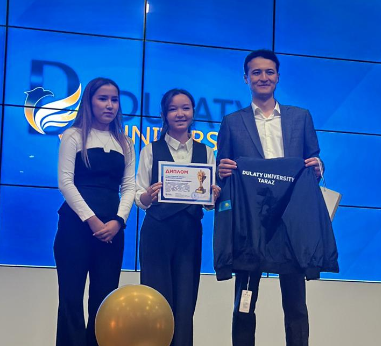
The moment of being awarded in the "Best Student Dean’s Office" category.

Asel Tokpanova is the winner of the national grant project "Generations of Independence" (Tauelsizdik Urpaktary).


A festive event for the elderly was held at the Special Social Services Center No. 2.


The faculty instructors won the 3rd prize in the "Densaulyk" (Health) Spartakiad.
Material and technical base
Material and Technical Base of the Faculty
The faculty is fully equipped with all necessary educational materials for the preparation of educational programs. The faculty buildings comply with sanitary standards and are equipped with fire safety systems. Lecture halls, laboratory facilities, classrooms, dormitories, sports complexes, and other facilities meet approved standards and regulations.
Department of Mathematics
The department has 16 specialized classrooms and offices, including:
- Academician M. Otelbayev Auditorium (5.1-402)
- Professor M. Muratbekov Auditorium (5.3-503)
- "Methods of Teaching Mathematics" Auditorium (5.3-510)
- Graduate Student Office (5.3-501)
- Faculty Offices (5.3-508, 5.3-515)
A number of classrooms are equipped with computer hardware and multimedia tools (computers, printers, interactive whiteboards).
Department of Physics and Informatics
The department manages 18 classrooms, laboratories, and computer labs, including:
- Faculty Offices (5.3-305, 5.3-313)
- Lecture Halls (5.3-304, 5.3-203)
- Innovative Technologies in Education Room (5.3-204)
- Multimedia Classroom (5.3-206)
- Astronomy Office (5.3-310)
- "Arduino UNO" Lecture Hall (5.2-301)
- "Lego Mindstorms EV3" Robotics Lab (5.2-302)
- Radio Electronics Room (5.3-312)
- School-type Physics Classroom (5.3-309)
Specialized Laboratories:
- Optics and Atomic and Nuclear Physics (5.2-303)
- Electricity and Magnetism (5.2-304)
- Molecular Physics (5.2-305)
- Mechanics (5.2-306)
- Computer Labs (5.3-202, 5.3-209, 5.2-300)
Department of Biology
The department is fully equipped with specialized laboratories and high-tech instruments:
- Spectrophotometer: An optical instrument for measuring the intensity of light beams relative to wavelength. Used to measure the emissivity, absorption, and reflectivity of bodies in the $0.185–200 \mu m$ range.
- SOPTOP EX30 Laboratory Microscope: Features a wide field of view (22 mm eyepieces) and is equipped with binocular or trinocular tubes. Supports phase contrast, polarization modules, and a digital tablet camera for photo fixation.
Key Laboratories and Facilities:
- 2.202 — Applied Biology Lab
- 3.402 — Plant Anatomy and Morphology Lab
- 3.404 — Human and Animal Physiology Lab
- 3.409 — Bioinformatics and Artificial Intelligence Lab
- 3.415 — Plant Physiology, Microbiology, and Virology Lab
- 3.416 — Genetics and Molecular Biology Lab
- 3.212 — Lecture Hall and "Zoological Museum"
- 3.407 — Innovative Educational and Methodological Biology Room
Department of Chemistry
The department has 14 classrooms and laboratories, including graduate student offices (5.3.306) and faculty rooms (5.3.207, 5.3.208). Laboratories (5.2.201, 5.2.203-206, 5.3.215) and the preparation room (5.2.207) are fully stocked.
Equipment: Analytical and technical scales, drying cabinets, muffle furnaces, spectrophotometers (DR 2800, DR 3900), KFK-3 photoelectric colorimeter, HANNA photometer, IRF-24 refractometer, ion meters (EV-74, pH-160 M), rotational viscometer, magnetic stirrers, etc. Innovative teaching technologies have been implemented.
Department of History and Geography in Education
Students and graduate students study in buildings No. 2.5 and 5.3. The infrastructure includes 4 computer labs, 1 resource center, a library lending desk, and a reading room with local network and internet access.
Commemorative Classrooms and Halls, Professor and WWII Veteran Sh. A. Adilov Room (2.5-314). Professor Zh. K. Bodanov Room (2.5-316). Associate Professor R. Bailybekov Methodological Classroom (2.5-327). Professor R. Myltykbaev Lecture Hall (2.5-318). Halyk Kaharmany (People's Hero) G. Baitasov Lecture Hall (2.5-425).
A number of classrooms are equipped with multimedia equipment and interactive whiteboards.
Achievements
The winners of the competition for grant funding for young scientists' research under the "Zhas Galym" project for 2025-2027 include two teachers from the Faculty of Natural Sciences at M. Kh. Dulati Taraz University:


Gulnur Turatayevna Yerkebulan, Associate Professor (Associate Professor) of the Physics and Computer Science Department, PhD, is pursuing a research project in the priority area of "Advanced Manufacturing, Digital, and Space Technologies": "An Adaptive Text Translation and Kazakh Language Teaching System Based on Neural Network Algorithms" (IRN AP25793799).
Asel Askarovna Karabaeva, Senior Lecturer of the Biology Department: "Creating an Ecologically Friendly System for Protecting Apple Trees from Fruit Mites in Southeastern Kazakhstan" (IRN AP25797095)
ANOTHER GREAT ACHIEVEMENT IN SCIENCE AND INNOVATION
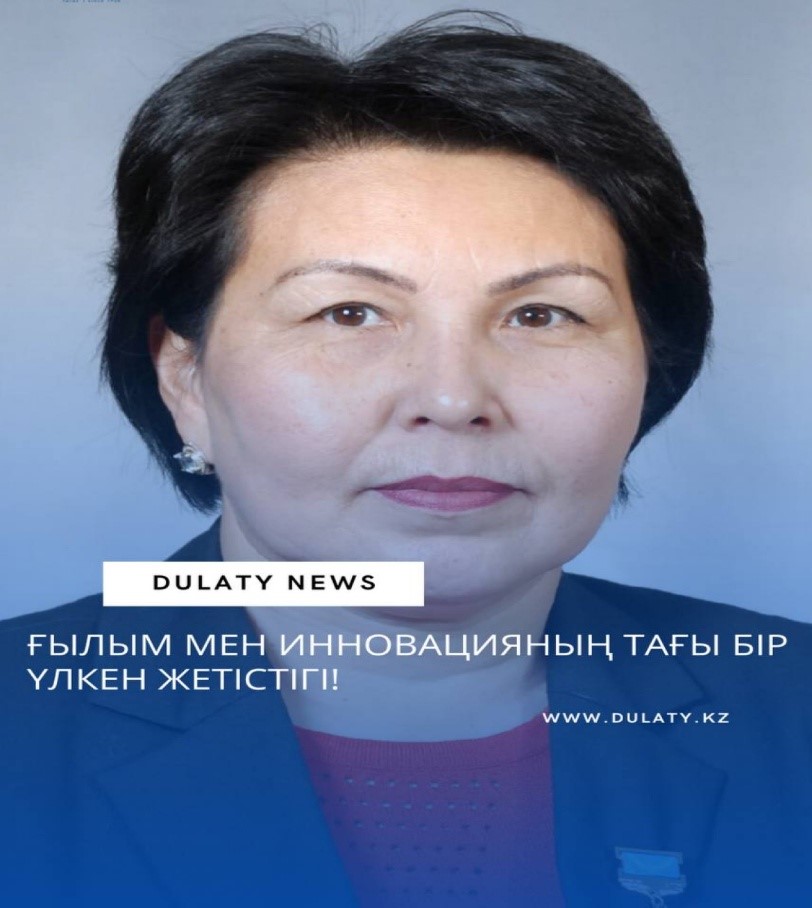
Gulnara Zieva, Head of the Biology Department at the Faculty of Natural Sciences at Dulati University, PhD in Biology, and Associate Professor, has received a grant of 350 million tenge for the 2025-2027 competition for the commercialization of scientific and technical results of the Ministry of Science and Higher Education of the Republic of Kazakhstan!
Project topic: "Implementation of agricultural technology for growing drought-resistant and high-yielding sorghum in the southern region of Kazakhstan with subsequent processing into grain crops."
Sorghum is an environmentally friendly plant adapted to arid climates and has great potential in agriculture. The implementation of this project will improve the country's food security and give new impetus to the agro-industrial sector. Furthermore, it opens the door to the introduction of innovative approaches in agriculture.
Congratulations to Gulnara Kerimbekovna! We wish her continued professional success, new achievements, and creative inspiration!
DULATI UNIVERSITY STUDENTS TAKE 1ST PLACE IN THE FUTURE MAKERS HACKATHON
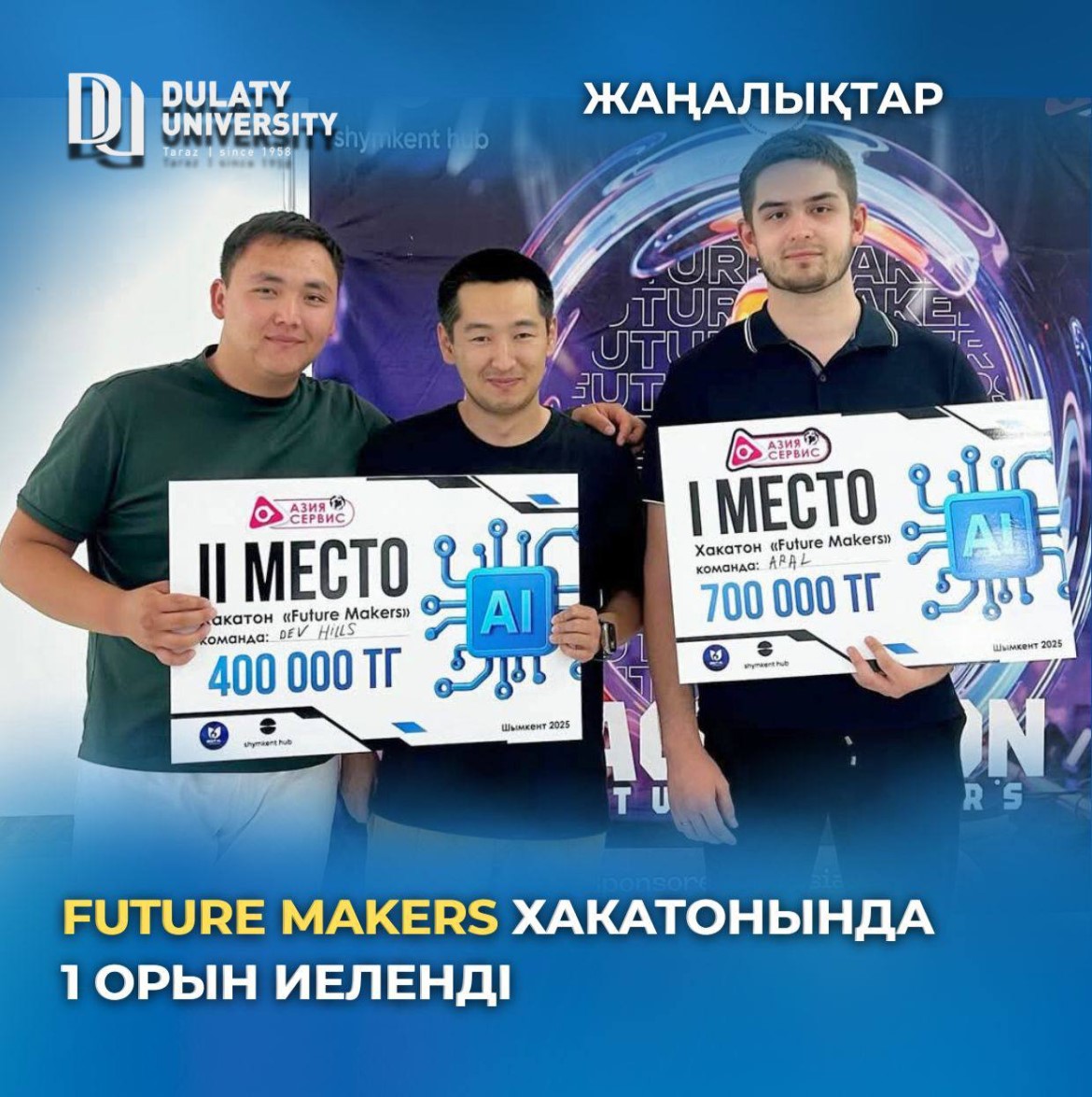
Students from the Faculty of Natural Sciences participated in the FUTURE MAKERS hackathon in Shymkent, where Aibek Seidazimov and Nikita Krasnobaev Shymkent took first place!
Our active students received a cash prize of 700,000 tenge for presenting their creative ideas and best projects!
May your success be many victories and achievements! We wish you continued success in your creative endeavors!
A STUDENT OF OUR FACULTY BECAME THE WINNER
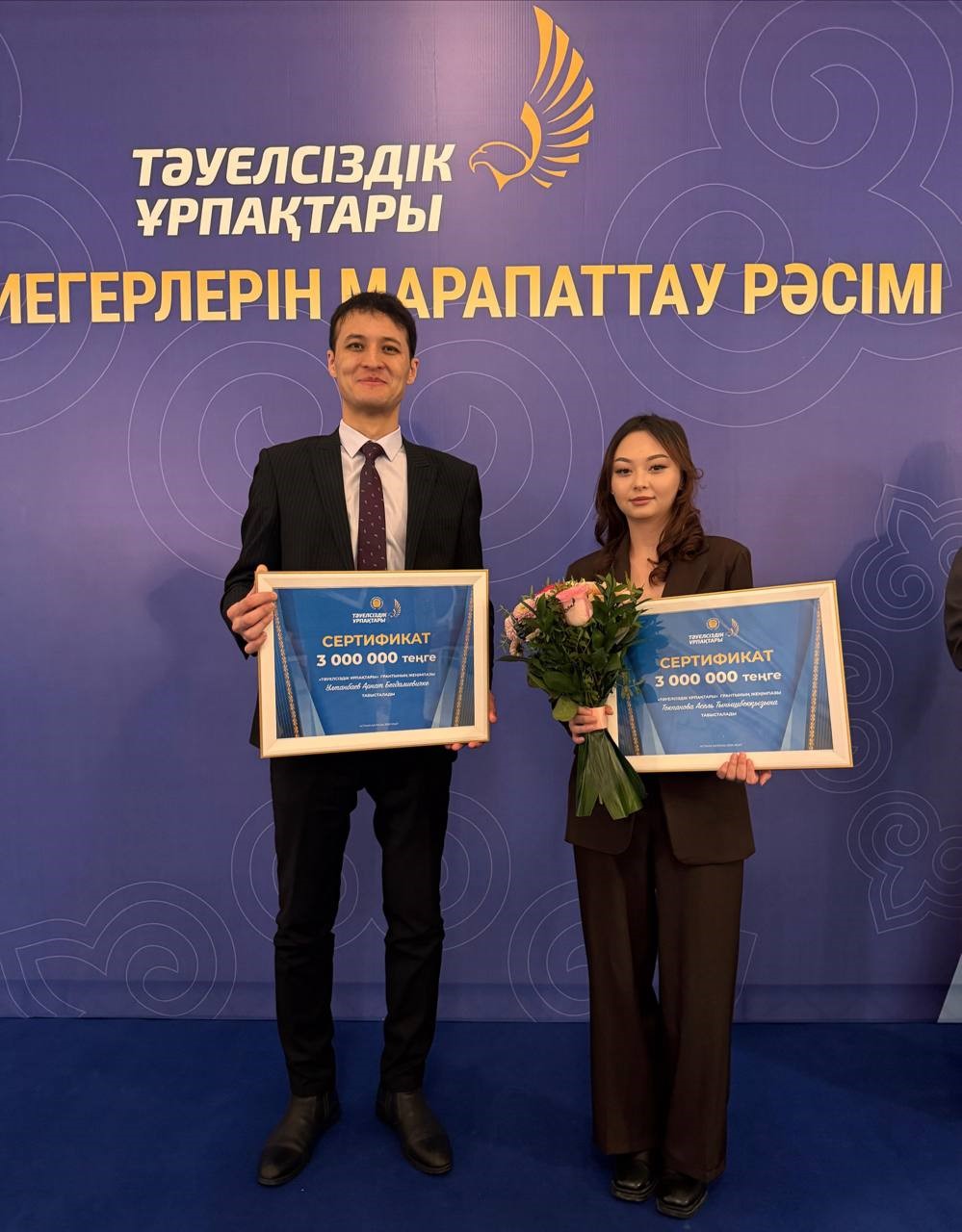
At the initiative of the head of state, the "Tauelsizdik Urpaqtary" grant is awarded annually to support new ideas and youth initiatives. The grant is awarded in the following areas: Science, Culture, Information Technology, Business, and Media, with financial support for each project amounting to 3 million tenge.
According to the results of this competition, Asel Tokpanova, a student at Taraz University named after M. Kh. Dulati, successfully defended her projects and received a grant of 3 million tenge in the Information Technology category.
This achievement is the result of the university's systematic work aimed at supporting youth initiatives and the active citizenship of students and staff.
ACHIEVEMENTS OF THE FACULTY OF NATURAL SCIENCES:
ACTIVE STUDENTS
Our alumnus
We are proud of our graduates | Faculty of Natural Sciences